If you already know what Kalshi is and just want the practical beginner walkthrough, this is the page you need.
Short answer: using Kalshi means creating an account, verifying your identity, funding with a bank account or debit card, choosing a market you actually understand, reading the resolution rules, and only then placing a small first order.
If you searched for:
how to use kalshikalshi tutorialhow does kalshi workkalshi sign up
this guide covers that same beginner workflow from start to finish.
This tutorial is for beginners who want the steps in order, without piecing them together from scattered help articles. It focuses on doing the basics correctly the first time.
If you need the background first, read What Is Kalshi?. The short version: Kalshi is a CFTC-regulated US exchange that trades Yes/No event contracts and settles in plain US dollars. That is the biggest practical difference from a crypto-native platform like Polymarket — there is no wallet, no seed phrase, and no on-chain funding step. If you have already used Polymarket and want the side-by-side onboarding comparison, read How to Use Polymarket.
TL;DR
- Kalshi is fiat-first: sign up, verify your identity, then fund with a bank account or debit card. No crypto wallet required.
- Markets are Yes/No event contracts priced between 1 and 99 cents, settling at 100 cents or 0.
- Use CoinRithm's Kalshi hub to research markets before you ever open an account.
- Try paper trading with mock USD first so your first real order is not also your first time reading an order book.
- Read the resolution rules before every trade — this is where beginners lose money, not on the mechanics.
What You Need Before You Start
| Requirement | Why It Matters |
|---|---|
| A US residential address and government ID (or check current international access) | Kalshi is a regulated exchange and verifies identity before you can fund an account |
| A bank account or debit card | Funding is fiat — no wallet or stablecoin involved |
| One simple market you understand | Your first order should test process, not creativity |
| Willingness to read the resolution rules | Most beginner mistakes happen before clicking buy |
Before You Start
Before you use Kalshi, understand what it is and what it is not.
Kalshi is:
- a CFTC-regulated Designated Contract Market — the same regulatory classification as major US futures exchanges
- funded and settled in US dollars, not crypto
- built around binary Yes/No event contracts
It is not:
- a crypto wallet or blockchain-based product
- a guaranteed-profit tool
- a place to skip reading resolution rules
The onboarding difference that matters most for beginners: Kalshi does not require a wallet. You sign up with an email (or Google/Apple), verify your identity the way you would for a brokerage account, and fund from a bank or card. That is a meaningfully lower-friction start than a crypto-native platform, but it comes with its own step that Polymarket does not have — identity verification — which is covered in Step 1.
Quick Start Checklist
If you want the shortest possible answer to how to use Kalshi for beginners, follow this order:
- confirm Kalshi is available for your situation (US-first, with limited international access — verify current terms)
- create an account and complete identity verification
- link a bank account or debit card and fund it
- choose a simple market you actually understand
- read the resolution rules before buying anything
- place a small first order
- monitor the position and withdraw when you are ready to cash out
Step 1: Create Your Account and Verify Your Identity
Kalshi is a regulated exchange, so account creation includes an identity check that a crypto-native platform does not require.
Signing up:
- Visit Kalshi and choose to sign up.
- Create an account with email and password, or continue with Google or Apple.
- Provide the basic details Kalshi asks for to begin verification.
Identity verification (KYC):
Because Kalshi is CFTC-regulated, it has to confirm who you are before you can trade with real money. In practical terms that generally means:
- confirming you meet the minimum age requirement and hold a valid US residential address (not a PO box)
- entering your legal name, date of birth, and other identifying details exactly as they appear on your government ID
- uploading a photo ID and completing a live selfie check so the details match
Verification is often quick, but can take longer if manual review is needed — for example if your submitted details do not match cleanly. Requirements, timing, and international availability change, so check Kalshi's current help center before you start if anything above doesn't match what you see on screen. If your bigger question is whether Kalshi is even usable from where you live, read Is Kalshi Legal? State-by-State — the federal CFTC approval is settled, but a handful of states have separately pushed back on Kalshi's sports contracts specifically, which is a different question from whether you can open an account at all.
Step 2: Fund Your Account
Once your account is verified, you fund it the way you would a brokerage account — no wallet, no network selection, no seed phrase.
The common methods:
- Bank transfer (ACH) — the standard method for US users. Typically no fee, though it can take a few business days for a transfer to fully settle even if some funds are made available to trade sooner.
- Debit card — usually the fastest way to get funded, generally credited close to instantly, but can carry a processing fee that a bank transfer does not.
- Wire or crypto — available as alternative funding paths on Kalshi, more relevant to larger transfers or international users.
Beginner-safe approach:
- start with a small amount
- only fund what you are comfortable risking while you are still learning the mechanics
- confirm the funds have actually settled and are usable before you try to place an order
Exact deposit minimums, fees, and settlement timing can change — always check Kalshi's current terms before you fund an account. For the cost of trading itself once you're funded, read Kalshi Fees Explained, which breaks down the per-contract trading fee formula and why a 50/50 market costs more to trade than a lopsided one.
Step 3: Find a Market You Understand
Kalshi markets are structured as event contracts: a Yes/No question that settles at 100 cents if it resolves Yes, or 0 cents if it resolves No. The current price — somewhere between 1 and 99 cents — reflects the market's implied probability that Yes happens.
The cleanest beginner workflow is to research markets before you ever open Kalshi itself. Use CoinRithm's Kalshi hub to browse what's currently active, see live odds and volume, and compare the same event across Kalshi and other venues — all without a Kalshi account.
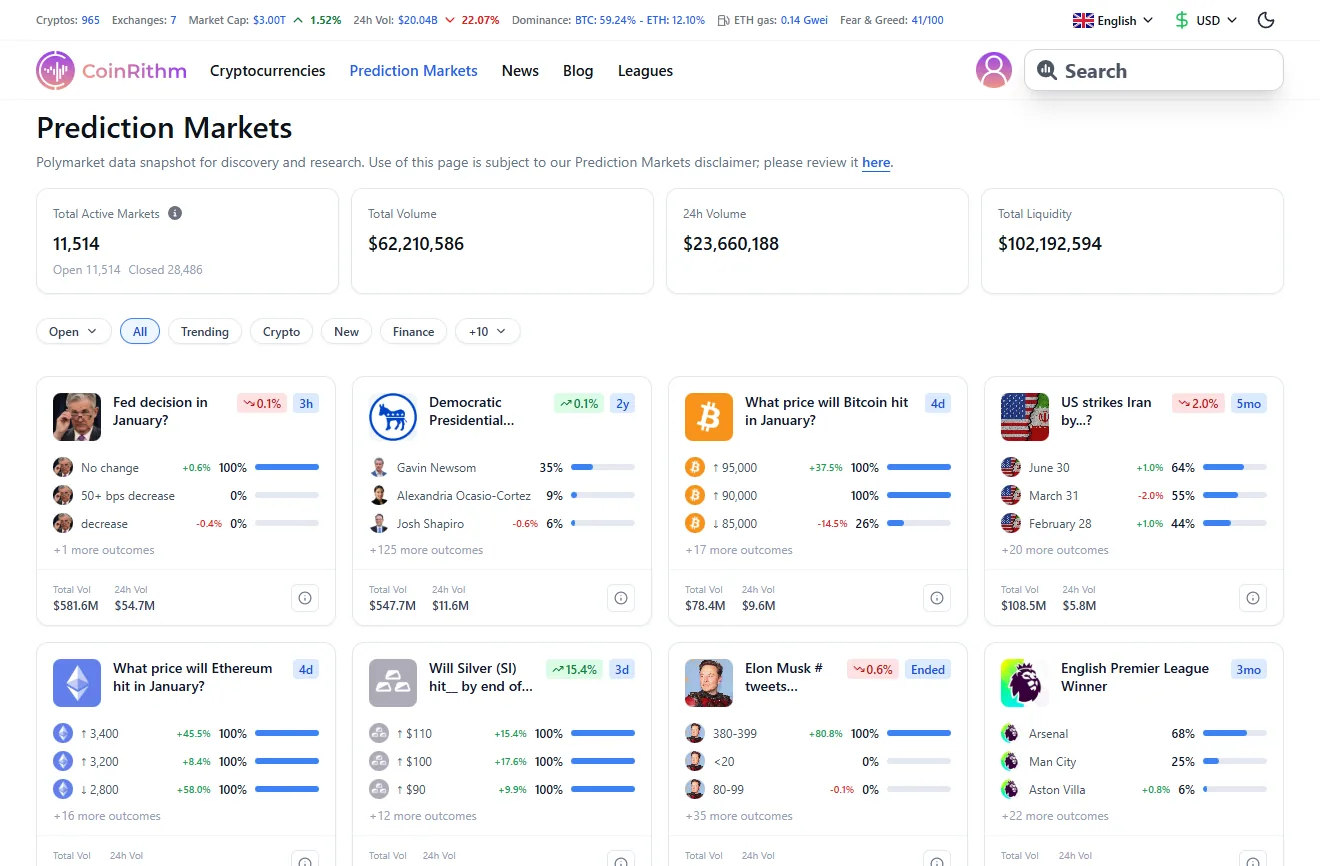
Use CoinRithm to narrow the market before you open an order on Kalshi.
Kalshi's markets span categories including economics (Fed decisions, CPI), finance, politics, weather, and more. Good beginner filters:
- you understand the topic without needing to look anything up
- the contract wording is specific, not vague
- the market has enough visible liquidity to enter and exit cleanly
- you are not choosing it because it is trending
The best first market is usually liquid, simply worded, and tied to an event you can actually follow to resolution.
Step 4: Place Your First Order
Before placing an order, read the resolution rules for that specific market: the exact question, the resolution date, and the data source Kalshi uses to determine the outcome. This is the single most important step and the one beginners skip most often.
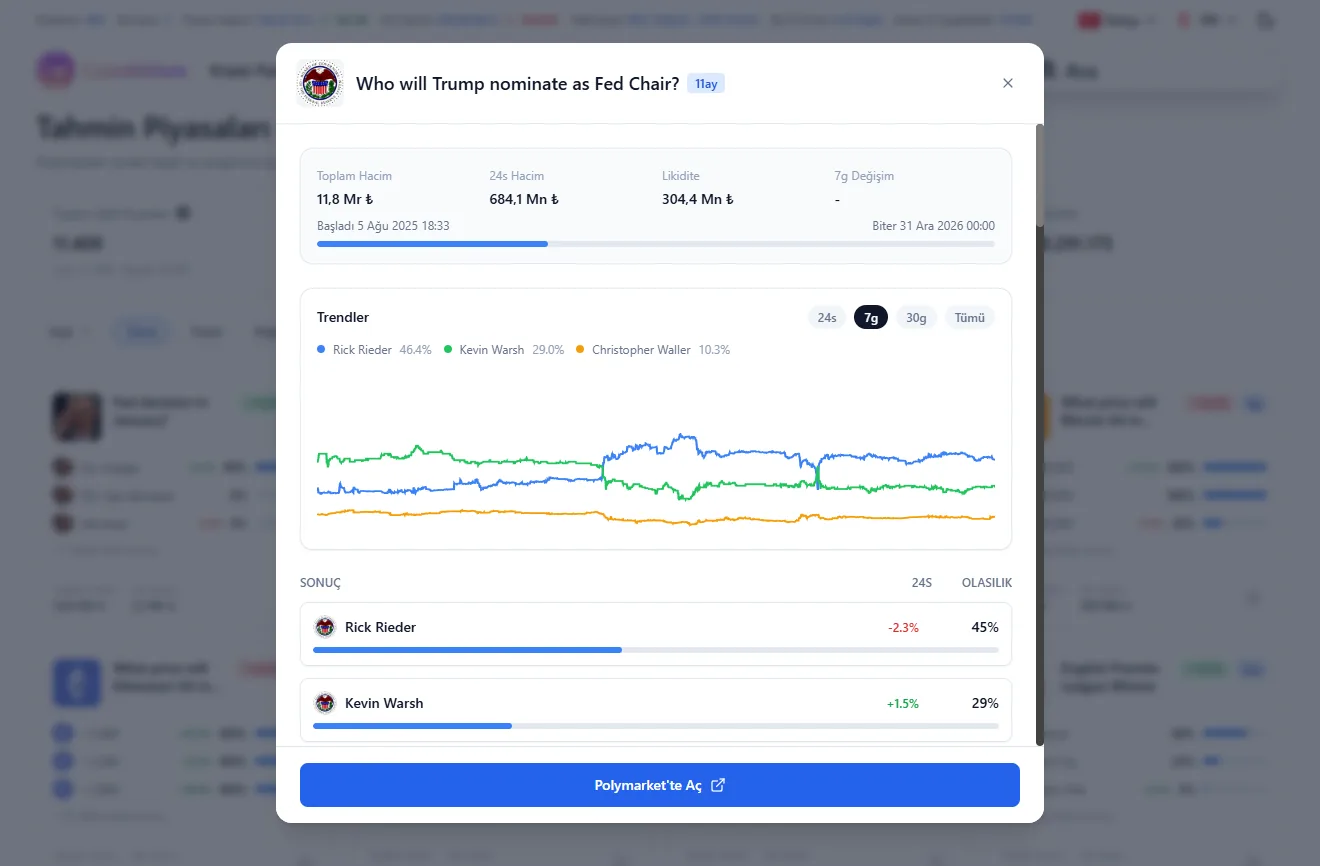
Read the resolution rules before you place an order.
Order basics:
- Market order — fills immediately at the best available price. Simple, but you take whatever the current spread offers.
- Limit order — you set the price you're willing to pay and it rests on the order book until someone matches it. This is the "maker" side, which generally costs less in fees than taking a market order — see Kalshi Fees Explained for the exact formula.
Simple beginner example:
- Buy
100Yes contracts at40cents each - Total cost =
$40 - If the market resolves Yes, each contract pays
100cents — gross payout of$100, profit of$60 - If the market resolves No, each contract pays
0— you lose the$40
That example is intentionally small. Your first order should test whether you understood the rules and the price, not maximize size.
Step 5: Track the Position and Exit Early
After your order fills:
- watch the price and the underlying event, not just your account balance
- keep re-checking whether your original reasoning still holds
- remember prices move continuously as new information comes in — you do not have to wait for final resolution
You can usually sell out of a position before the market resolves, locking in a gain or cutting a loss, the same way you could exit early on any other prediction market platform. That flexibility matters because the value of a contract often shifts well before the underlying event is decided.
Step 6: Withdraw
When you're ready to take money out, Kalshi only lets you withdraw settled cash that isn't tied up in an open position — you'll need to close or wait for markets to resolve first.
The short version: for US users, bank transfer (ACH) is the standard free method and typically takes a few business days; a debit card withdrawal is usually the faster option; international users generally rely on debit card or crypto rather than a bank transfer.
For the full breakdown of all three withdrawal methods, timing, and fees, read How to Withdraw from Kalshi.
Common Beginner Mistakes on Kalshi
- Rushing identity verification — blurry ID photos or details that don't exactly match your government ID are the most common reason verification stalls.
- Assuming international access matches the US experience — bank funding and bank withdrawals are US-focused; check current terms if you're outside the US.
- Trading 50/50 markets repeatedly without noticing the fee — the trading fee is highest on coin-flip contracts and lowest on lopsided ones; see Kalshi Fees Explained.
- Skipping the resolution rules — a market can look obvious, but the written rules define the outcome, not your intuitive reading of it.
- Treating "Kalshi is regulated" as "every Kalshi market is available everywhere" — the federal CFTC approval is settled, but some states have separately contested Kalshi's sports contracts; see Is Kalshi Legal? State-by-State.
- Sizing too large on a first order — the goal of your first few trades is learning the process, not maximizing the win.
How CoinRithm Fits In
You don't need a Kalshi account to start learning how Kalshi markets behave.
- Research first. Browse live Kalshi odds, volume, and category filters on the Kalshi hub on CoinRithm before you ever fund an account.
- Compare across venues. If the same event trades on Kalshi and elsewhere, CoinRithm lets you see how each venue is pricing it side by side.
- Practice with paper trading. CoinRithm's paper trading lets you simulate a position on a Kalshi-listed event with mock USD before you risk real money on Kalshi itself. CoinRithm is an independent aggregator and research tool — it is not affiliated with Kalshi, and paper trades placed on CoinRithm are entirely separate from real Kalshi contracts.
Frequently Asked Questions
Do I need cryptocurrency to use Kalshi?
No. Kalshi is funded and settled in US dollars. You fund your account with a bank transfer or debit card — no wallet, network, or stablecoin is involved.
How do I sign up and verify my identity on Kalshi?
Create an account with email or a Google/Apple sign-in, then complete identity verification, which generally requires your legal name, date of birth, address, and a government photo ID. Verification is often quick but can take longer if manual review is needed. Check Kalshi's current help center for the exact current requirements.
How much does it cost to trade on Kalshi?
Kalshi charges a trading fee that scales with the contract price, peaking on 50/50 markets and shrinking toward the extremes, plus a maker/taker split. Deposits and bank withdrawals are typically free. See Kalshi Fees Explained for the full formula.
What is the minimum deposit on Kalshi?
Deposit minimums and fees can change. Check Kalshi's current terms directly before funding an account rather than relying on a fixed figure here.
Can I sell before the market resolves?
Yes. You can typically exit a position early, locking in a gain or cutting a loss, rather than holding every position to final resolution.
Is Kalshi legal in my state?
Kalshi's CFTC approval covers it federally, but a number of states have separately challenged Kalshi's sports event contracts specifically. Read Is Kalshi Legal? State-by-State for the current picture.
How is this different from using Polymarket?
Kalshi is fiat-first and requires identity verification; Polymarket is crypto-native and requires a wallet funded with USDC on Polygon but no identity check. If you're deciding between the two or already know Polymarket, read How to Use Polymarket for the equivalent walkthrough.
Conclusion
Using Kalshi safely is mostly about process, and the fiat-first onboarding removes the wallet friction a crypto-native platform requires — but it adds an identity verification step in its place.
The basic order is:
- create an account and verify your identity
- fund with a bank transfer or debit card
- find a market you actually understand
- read the resolution rules carefully
- place a small first order
- track the position, exit early if needed, and withdraw when ready
If you follow that order, you avoid most of the mistakes that trip up new Kalshi users.
Start with the Kalshi hub on CoinRithm for research, try paper trading to get comfortable with the mechanics, and only then move to funding a real Kalshi account.
Continue reading: Prediction Market Volume and Open Interest Explained.
Last Updated: July 4, 2026
Disclaimer: This article is for educational purposes only and is not financial advice. CoinRithm is an independent research and aggregation platform and is not affiliated with Kalshi. Identity verification requirements, deposit and withdrawal methods, fees, and country availability can change — always verify current terms directly with Kalshi before funding an account or placing a trade. Only trade money you can afford to lose.
