Trying to keep up with crypto spread across exchanges, wallets, and random coin purchases?
Crypto portfolio tracking helps you see what you own, what you paid, how each position is performing, and whether your overall allocation still makes sense. Without that view, it is easy to overexpose yourself to one coin, forget your cost basis, or mistake price movement for actual progress.
This guide explains how to track a crypto portfolio properly, what metrics matter most, and how to build a simple routine you can actually maintain. I use CoinRithm's Portfolio feature as the working example, but the workflow applies to any portfolio tracker.
TL;DR
- A crypto portfolio tracker helps you monitor holdings, cost basis, allocation, and profit/loss in one place.
- The most important beginner metrics are total value, average cost, allocation, and unrealized P&L.
- Good tracking reduces emotional decisions because you can see the full picture instead of reacting coin by coin.
- Manual tracking is slower than exchange sync, but it gives you control and works across multiple exchanges and wallets.
- If you also practice trading, pair portfolio tracking with crypto paper trading so you keep real holdings and practice positions separate.
What Is Crypto Portfolio Tracking
Crypto portfolio tracking means keeping an updated record of your holdings so you can monitor:
- which coins you own
- how much of each coin you hold
- what price you paid on average
- what your positions are worth now
- how your overall portfolio is allocated
In simple terms, it is the difference between saying "I think I own some BTC, ETH, and SOL" and knowing exactly how much exposure you have, where it sits, and whether you are up or down.
Why Portfolio Tracking Matters
Most beginners focus on price, not portfolio structure. That creates blind spots.
Portfolio tracking matters because it helps you:
- avoid overconcentration in one coin
- see whether recent buys actually improved your position
- separate long-term holdings from short-term ideas
- measure performance without guessing
- make calmer decisions during volatile markets
If you also trade actively, a tracker gives you context. If you invest more passively, it gives you discipline.
The 4 Metrics You Should Watch First
You do not need 30 metrics to manage a beginner portfolio well. Start with these four.
1. Total Portfolio Value
This is the current value of everything you hold combined.
Use it to answer:
- how much crypto exposure do I actually have?
- is my portfolio growing because of new deposits or because holdings are performing?
- how much risk am I carrying relative to cash and other assets?
2. Average Cost Basis
Your average cost basis is the average price you paid for each asset.
This matters because it shows whether you are:
- averaging up
- averaging down
- sitting on gains
- still underwater on a position
Without cost basis, portfolio tracking becomes shallow. You can see price, but you cannot judge the position.
3. Allocation by Coin
Allocation tells you what percentage of your total portfolio sits in each asset.
For example:
- BTC: 45%
- ETH: 25%
- SOL: 15%
- USDT: 15%
This is one of the fastest ways to spot hidden risk. A portfolio can look diversified by number of coins while still being badly concentrated.
4. Profit and Loss (P&L)
P&L shows how each asset and the total portfolio are performing relative to your cost basis.
Track both:
- unrealized P&L for coins you still hold
- realized P&L for positions you already closed, if your tracker supports it
For most beginners, unrealized P&L is enough to start with.
How to Track Your Crypto Portfolio Step by Step
Step 1: List Every Exchange and Wallet
Start with a complete inventory.
Write down every place where you hold crypto:
- centralized exchanges
- hardware wallets
- software wallets
- small side accounts you forgot about
If you skip accounts, your tracking will be wrong from the start.
Step 2: Group Holdings by Purpose
Do not dump everything into one mental bucket.
A better structure is:
- long-term holdings
- active trading capital
- high-risk altcoin positions
- stablecoins or cash equivalents
If your tracker allows multiple portfolios, this is a good way to organize them. For example, one portfolio for long-term investing and another for shorter-term ideas.
Step 3: Add Cost Basis and Quantity
For each asset, record:
- coin name
- quantity
- average cost
- where it is held
This is the minimum data you need for useful tracking.
On CoinRithm, the Portfolio feature lets you create portfolios, add assets manually, and update quantities or cost basis as your holdings change.
Step 4: Review Allocation and Risk
Once your holdings are in one place, check whether the portfolio still reflects your intent.
Ask:
- is one coin taking over the portfolio?
- do I have too many tiny positions to manage properly?
- am I holding stablecoins for a reason or by accident?
- do I still agree with my biggest positions?
This is where tracking becomes decision-making instead of recordkeeping.
Step 5: Create a Weekly Review Habit
Portfolio tracking only works if you revisit it.
A simple weekly review is enough for most beginners:
- update any recent buys or sells
- check allocation changes
- review biggest winners and losers
- decide whether any position needs attention
- leave everything alone if nothing material changed
The point is clarity, not constant action.
Manual Tracking vs Exchange Sync
There are two common ways to track a crypto portfolio.
Manual tracking
Pros:
- full control over what gets tracked
- works across exchanges and wallets
- useful if you want to separate real holdings from practice accounts
- avoids API access concerns
Cons:
- slower to maintain
- depends on you entering data correctly
- can get messy if you trade very frequently
Automatic sync
Pros:
- faster updates
- better for high activity accounts
- less repetitive data entry
Cons:
- depends on exchange support
- can create privacy or access concerns
- sometimes imports messy or incomplete data
If you are a beginner or a lower-frequency investor, manual tracking is often enough.
How CoinRithm Portfolio Tracking Works
CoinRithm's Portfolio feature is designed for manually tracking holdings across your accounts.
You can use it to:
- create multiple portfolios
- add coins from coin pages
- update quantities and costs
- view total value, total cost, and total P&L
- expand each portfolio for a more detailed asset breakdown
That setup is especially useful if you want to keep:
- real holdings separate from paper trading
- exchange-specific holdings organized
- long-term and experimental allocations apart
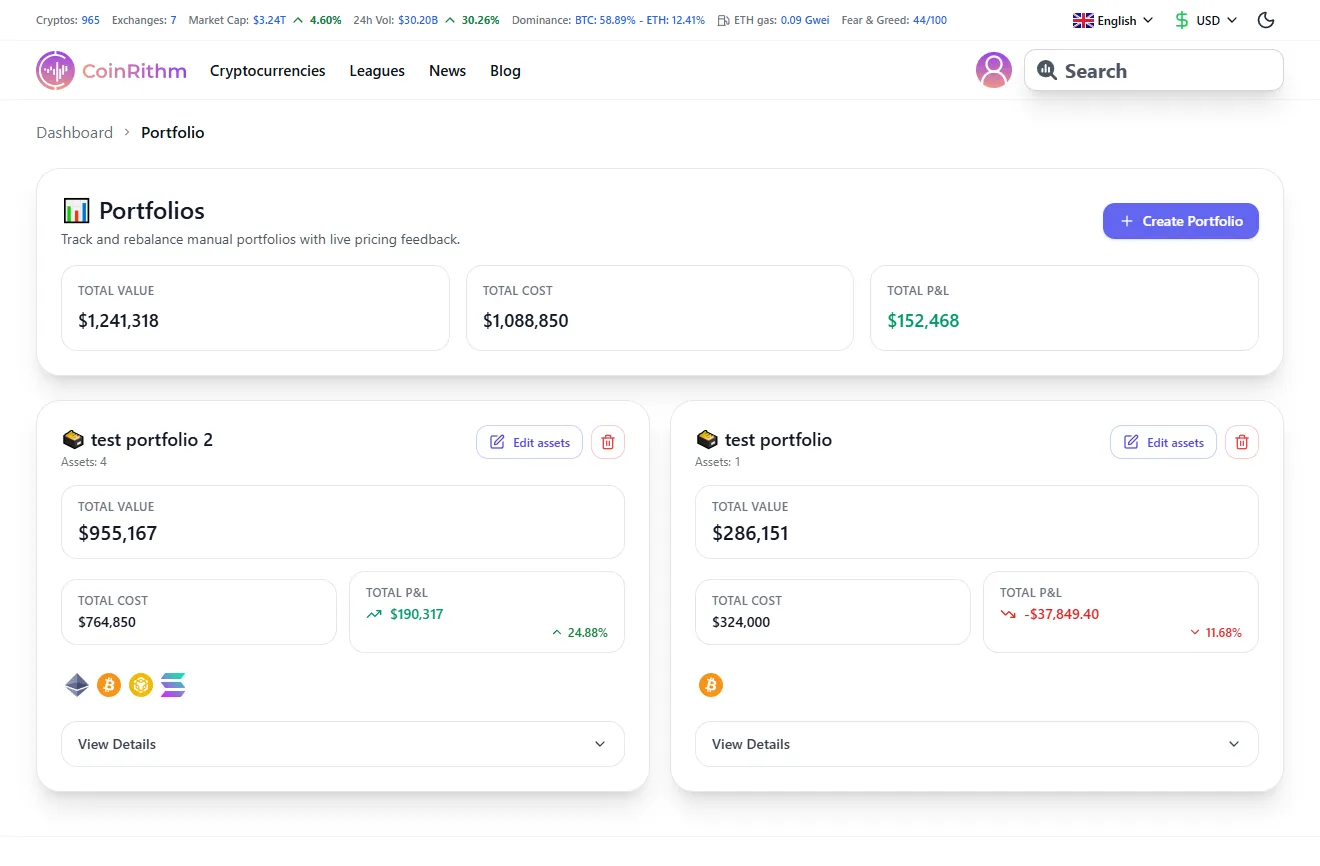
Figure: Portfolio page showing multiple portfolios with Total Value, Cost, and P&L metrics.
Common Crypto Portfolio Tracking Mistakes
Tracking price but not cost basis
If you only know today's price, you still do not know whether a position is doing well for you personally.
Mixing real holdings with practice trades
If you use a paper trading account, keep it separate. Practice performance and real holdings should not live in the same mental or reporting bucket.
If you want to practice execution separately, use CoinRithm's paper trading simulator or follow this guide on how to paper trade crypto.
Ignoring allocation drift
One strong-performing coin can quietly become too large a share of your portfolio.
Tracking too many tiny positions
A portfolio with 20 tiny coins often feels diversified, but it is usually harder to manage and easier to neglect.
Reviewing too often
Tracking is supposed to improve clarity. If you check your portfolio every 15 minutes, it can push you toward emotional decision-making instead.
Portfolio Tracking vs Watchlists vs Paper Trading
These three tools serve different jobs:
Portfolio tracking
- for coins you already own
- helps monitor value, allocation, and P&L
Watchlist
- for coins you are interested in but have not committed to
- helps you monitor names before acting
If you need a pre-trade research layer before buying, use a watchlist first. Here is our guide on how to use a crypto watchlist before you trade.
Paper trading
- for practicing entries, exits, and risk management with virtual funds
- helps you test execution without risking real money
Use the right tool for the right job.
If you want to practice decision-making before buying, start with a watchlist. If you want to practice trading mechanics, start with paper trading. If you already own assets, portfolio tracking is the core layer.
If your main problem is consistency rather than tracking, read how gamification can improve paper trading discipline.
Frequently Asked Questions
What is the best way to track a crypto portfolio?
The best way is the one you will maintain consistently. For most beginners, that means a simple tracker showing holdings, average cost, allocation, and P&L in one place.
Should I track crypto manually or automatically?
Manual tracking is fine for many beginners and long-term holders. Automatic sync is more useful if you trade frequently and need faster updates.
What should a crypto portfolio tracker include?
At minimum:
- coin name
- quantity
- average cost basis
- current value
- profit/loss
- portfolio allocation
Is portfolio tracking the same as paper trading?
No. Portfolio tracking is for monitoring real holdings. Paper trading is for practicing trades with virtual funds.
Can I track holdings from multiple exchanges in one place?
Yes. That is one of the main reasons people use a portfolio tracker in the first place.
How often should I review my crypto portfolio?
For most beginners, a weekly review is enough. Daily checking is fine if you are very active, but constant checking usually creates noise, not better decisions.
Conclusion
Crypto portfolio tracking is not just admin work. It is how you stay honest about what you own, what you paid, and how much risk you are actually taking.
If you can see your allocation, cost basis, and P&L clearly, your decisions improve. You stop reacting coin by coin and start managing the portfolio as a whole.
If you want a simple place to organize holdings, track your crypto portfolio on CoinRithm. If you want to practice trading separately before using real money, pair it with our guide on how to paper trade crypto. If you are still deciding what to buy, add a watchlist workflow before you act. If you want to stay informed on events that affect what you hold, follow CoinRithm Crypto News.


