Paper trading only works if you treat it like training, not entertainment.
That is harder than it sounds. When no real money is at risk, it is easy to overtrade, ignore stop-losses, and chase random setups because the consequences feel fake. This is where gamification can help, but only if it reinforces discipline instead of replacing it.
This guide explains how gamification can improve paper trading discipline, what kinds of progress systems actually help, and how to avoid turning a practice account into a score-chasing game. I use CoinRithm's leagues, tasks, and feedback loops as working examples, but the principles apply to any learning-oriented simulator.
TL;DR
- Gamification is useful when it reinforces good habits like planning, review, and consistency.
- It becomes harmful when it makes you chase points instead of following your trading rules.
- The best paper trading routine is simple: plan, execute, review, adjust.
- Streaks, tasks, and visible progress markers can help beginners stay consistent long enough to improve.
- If you need actual execution practice, start with paper trading. If you need market selection before that, use a watchlist.
Why Paper Trading Discipline Breaks Down
Most beginners do not fail at paper trading because the simulator is bad. They fail because they stop treating the environment seriously.
Common problems:
- entering trades without a plan
- risking unrealistic position sizes
- opening too many trades in a day
- skipping trade review
- changing rules after the fact
This happens because paper trading removes the natural pain of losing. That is helpful for learning execution, but it also weakens discipline if you do not add structure back in.
What Gamification Should Actually Do
Good gamification should make good habits easier to repeat.
That means it should reward things like:
- following a routine
- reviewing trades honestly
- practicing consistently
- managing risk properly
- improving over time
It should not reward:
- random activity for its own sake
- high trade count
- oversized bets
- leaderboard obsession without process quality
The right mindset is this: gamification is a support system for discipline, not a substitute for discipline.
The Best Paper Trading Loop: Plan, Execute, Review, Learn
If you remember one thing from this article, remember this loop:
- Plan the trade before you enter
- Execute the trade cleanly
- Review the outcome honestly
- Learn one thing before the next trade
That loop is simple, but it creates real progress.
Gamification is useful only when it nudges you back into that loop.
How Progress Systems Can Help Beginners
Leagues and Progress Tiers
Leagues can be useful because they make progress visible.
They help answer:
- am I showing up consistently?
- am I improving over time?
- do I have evidence of discipline, not just confidence?
The mistake is to confuse rank with readiness. A badge can tell you that you are engaged. It cannot tell you by itself that you are ready for live trading.
Tasks and Daily Challenges
Tasks are helpful when they reinforce the right behavior.
Examples of useful tasks:
- place one planned trade only
- record a stop-loss before entry
- review one closed trade
- journal one mistake and one improvement
The point is repetition. Good tasks turn abstract advice into a routine you can actually follow.
Achievements and Milestones
Achievements work best as milestone markers.
Useful examples:
- first 10 reviewed trades
- first 30 days of consistent journaling
- first month without revenge trading
- first 50 trades with position sizing rules intact
These are better than vanity milestones because they track process quality.
XP, Streaks, and Visible Progress
XP and streaks are not important by themselves, but they can help beginners stick with practice long enough to build skill.
Used properly, they answer:
- did I follow my process today?
- how long have I been consistent?
- am I improving my routine or just repeating mistakes?
Used badly, they encourage activity without reflection.
How CoinRithm Uses Gamification in Mock Trade
CoinRithm's paper trading environment includes a few layers that can support discipline:
- league rank to show visible progress
- tasks to reinforce repetition and routine
- achievements to mark milestones
- AI feedback to review specific trades after the fact
The important part is not the badge color or XP total. The useful part is whether those systems keep you doing the right work:
- planning entries
- controlling risk
- reviewing mistakes
- staying consistent
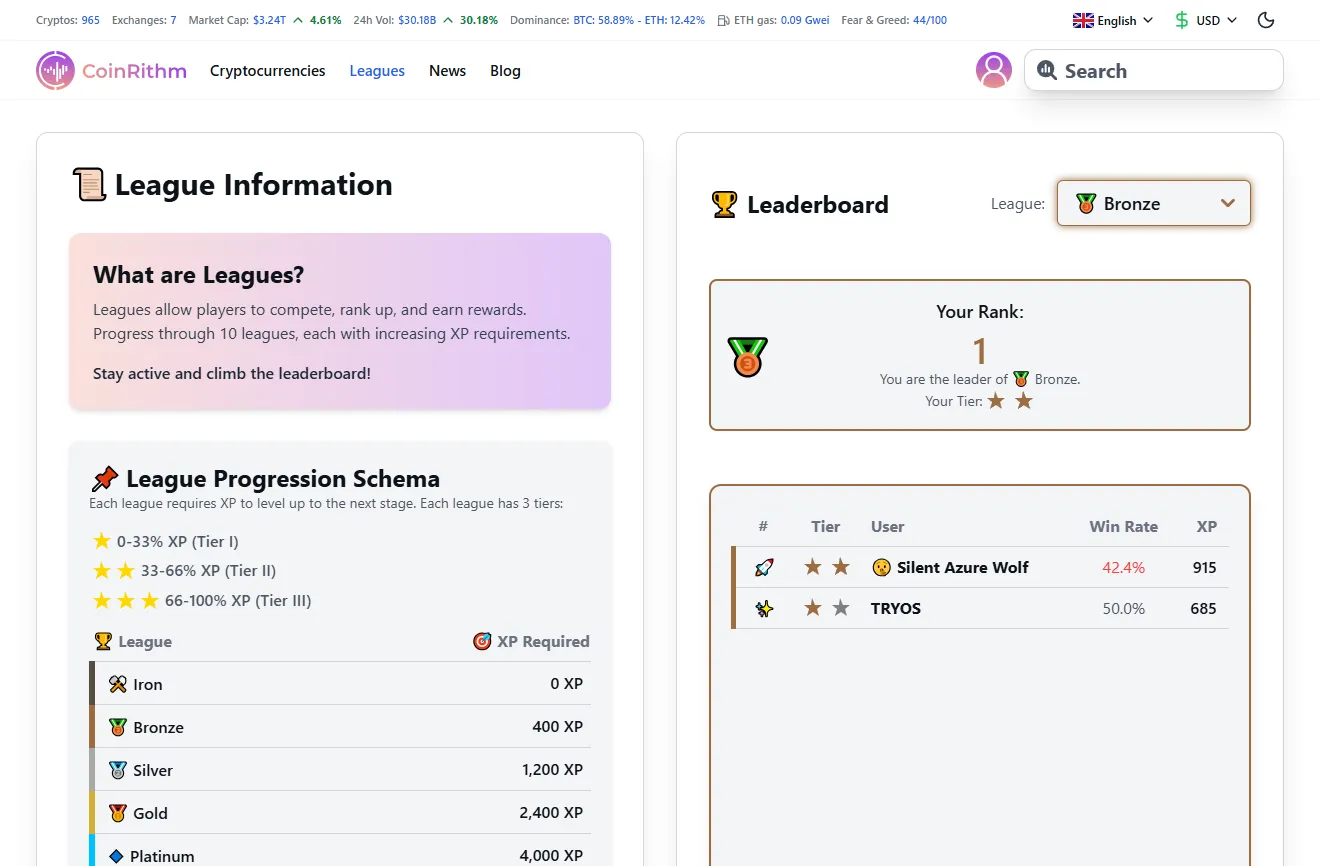
Figure: League system showing visible progress tiers for consistent Mock Trade activity.
Where Gamification Goes Wrong
Gamification starts hurting when the score becomes more important than the process.
Watch for these traps:
Chasing activity instead of quality
More trades does not mean more learning.
Treating leaderboard position as proof of skill
Visible progress can motivate you, but it should not replace actual performance review.
Ignoring risk because the environment feels fake
If you would never take the same trade with real money, it is probably teaching you the wrong lesson.
Using feedback as entertainment instead of correction
The point of review is to change behavior, not just read interesting commentary.
A Simple Discipline Routine for Paper Trading
If you want structure without overcomplicating things, use this:
Before the trade
- define entry
- define stop-loss
- define target or exit condition
- define position size
After the trade
- record what happened
- note whether you followed your plan
- identify one mistake or one good decision
- decide what to repeat or fix next time
If you need a clean execution environment for this process, start with our guide on how to paper trade crypto.
If you are not ready to trade yet and still need to narrow market focus, use a crypto watchlist first. If you are tracking real holdings separately, use a portfolio tracker.
Frequently Asked Questions
Does gamification actually help paper trading?
Yes, if it reinforces discipline and review. No, if it just encourages activity for the sake of points or rank.
What is the best habit to build in paper trading?
The best habit is consistent trade review. Most beginners improve faster when they review decisions honestly after each trade.
Are leagues and leaderboards useful?
They can be useful for motivation, but they are not a direct measure of readiness for real-money trading.
Should I care about XP in paper trading?
Only as a signal of consistency. XP is useful if it reflects good routines, not if it pushes you into low-quality trades.
What matters more: discipline or strategy?
Both matter, but most beginners fail because they cannot execute even a decent strategy consistently. Discipline is what turns ideas into repeatable behavior.
Conclusion
Gamification can improve paper trading, but only when it keeps you focused on habits that actually matter.
The goal is not to collect points. The goal is to build a routine that survives the move from simulated trading to real capital. If leagues, tasks, and streaks help you stay consistent, use them. If they distract you, strip things back to the core loop: plan, execute, review, learn.
Once your process is solid, CoinRithm's Agent Arena takes the competitive layer further: a public leaderboard using a published confidence-weighted realized-PnL contract with visible qualification and sample thresholds. It is the natural next step after private league rankings — real competition against other participants without risking actual capital.
If you want a simulator that includes those support systems, try CoinRithm Paper Trading — which covers spot, futures (up to 20x leverage), and prediction market mock stakes. Then pair it with our guides on paper trading, watchlists, and portfolio tracking.


