Do you keep jumping into coins too fast just because they are moving today?
A crypto watchlist gives you a buffer between noticing a coin and committing money. Instead of reacting impulsively, you can track price behavior, compare it with the price when you first noticed it, and decide whether the setup still makes sense.
This guide explains how to use a crypto watchlist properly, what to track, and how to turn a watchlist into a pre-trade filter instead of a random list of coins. I use CoinRithm's Watchlist as the working example, but the workflow applies to any solid watchlist tool.
TL;DR
- A crypto watchlist helps you track coins before you buy or trade them.
- The key benefit is context: you can compare current price with the price when you first added the coin.
- A good watchlist prevents impulse trades and helps you build a repeatable pre-trade routine.
- Watchlists are different from portfolio tracking and paper trading: each tool solves a different problem.
- If you want to practice actual entries and exits after building a watchlist, use paper trading.
What Is a Crypto Watchlist
A crypto watchlist is a shortlist of coins you want to monitor before taking action.
The point is not to collect as many coins as possible. The point is to keep high-signal names in front of you so you can:
- watch price behavior over time
- compare current price with the price where your interest started
- decide whether the setup is improving or breaking down
- avoid chasing every coin that appears on social media
Why a Watchlist Matters Before You Trade
Most bad trades start too fast.
You notice a coin moving, open the chart, feel urgency, and enter before you have enough context. A watchlist slows that process down in a useful way.
A good watchlist helps you:
- reduce impulsive entries
- focus on a manageable set of coins
- build familiarity with specific names
- notice when a setup improves over days instead of minutes
- separate research from execution
That last point matters most. Research and execution are different jobs.
What to Track on a Crypto Watchlist
At minimum, track:
- coin name
- current price
- price when you added it
- performance since added
- the reason you are watching it
If your watchlist tool shows live price vs added price, that is especially useful because it quickly tells you whether you are early, late, or still waiting for a better entry.
How to Build a Useful Crypto Watchlist
Step 1: Start with a Small List
Do not start with 40 coins.
For most beginners, 5 to 12 names is enough. That gives you enough choice without turning the watchlist into noise.
A simple starter mix could include:
- 2 large-cap coins
- 2 mid-cap names
- 1 or 2 higher-volatility ideas
Step 2: Record Why the Coin Is There
Every coin on your watchlist should have a reason.
Examples:
- watching for a pullback into support
- waiting for a breakout confirmation
- monitoring momentum after a news event
- studying the coin before deciding whether it belongs in your portfolio
If you cannot explain why the coin is there, it probably does not belong there.
Step 3: Compare Live Price vs Added Price
This is where a watchlist becomes more than a bookmark folder.
When you can compare the current price with the price when you added the coin, you can judge:
- whether you are chasing
- whether the setup improved after you noticed it
- whether patience would have helped
- whether your first instinct was early, late, or wrong
That feedback loop is useful even if you never trade the coin.
Step 4: Review the List on a Schedule
A watchlist only helps if you revisit it with some structure.
For most beginners, one or two reviews per day is enough:
- look at the biggest changes since added
- check whether any setup is close to your criteria
- remove distractions
- move only the best ideas toward execution
Step 5: Remove Coins That No Longer Fit
Watchlists get weak when they become storage.
Remove coins when:
- the setup is gone
- the reason for watching changed
- you already rejected the trade
- the idea has become stale
A smaller, cleaner watchlist is usually more useful than a crowded one.
How CoinRithm Watchlist Works
CoinRithm's Watchlist is built for that pre-trade workflow.
You can use it to:
- add coins from the homepage, coin pages, or the watchlist itself
- compare
Live / Added Price - see performance since the moment you added the coin
- view quick snapshots of the strongest and weakest performers
- keep a focused list before moving to portfolio tracking or paper trading
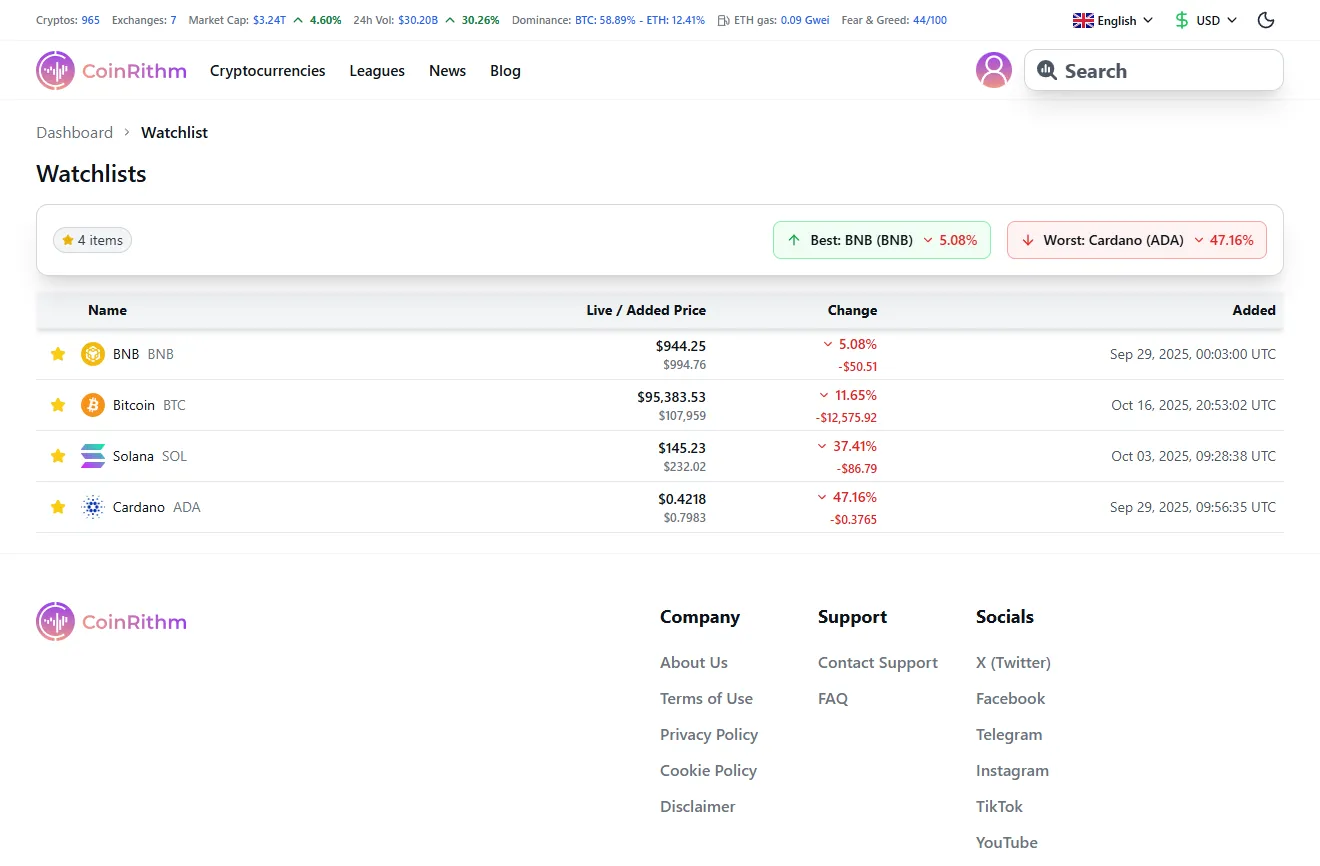
Figure: Watchlist showing coins with Live/Added Price comparison and performance since added.
Watchlist vs Portfolio vs Paper Trading
These tools work best when you do not mix their jobs.
Watchlist
- for coins you are still evaluating
- helps you observe before acting
Portfolio
- for coins you already own
- helps you track allocation, cost basis, and P&L
If you want to organize holdings you already own, use a portfolio tracker. Here is our guide on how to track your crypto portfolio.
Paper trading
- for practicing entries, exits, and trade management with virtual funds
- helps you test execution before risking real money
If you want to practice the trade itself after building a shortlist, use CoinRithm's paper trading simulator or follow our guide on how to paper trade crypto.
If your issue is not market selection but consistency, pair that with our guide on how gamification can improve paper trading discipline.
Common Crypto Watchlist Mistakes
Adding too many coins
If everything is on the list, nothing is really being watched.
Not defining the reason for interest
A watchlist should not just say maybe. It should tell you what you are waiting for.
Reviewing only after huge moves
If you check the watchlist only when social media is already loud, you lose much of the advantage.
Turning the watchlist into a portfolio
If you already own the coin, it should usually move into your portfolio tracker.
Skipping the next step
Watching is not enough forever. Once a setup is ready, either reject it or move it into execution.
Frequently Asked Questions
What is a crypto watchlist used for?
A crypto watchlist is used to monitor coins before you buy or trade them. It helps you track price behavior, compare current price with the price when you added the coin, and filter potential setups.
How many coins should be on a crypto watchlist?
For most beginners, 5 to 12 coins is enough. More than that often turns the list into noise.
Is a watchlist the same as a portfolio?
No. A watchlist is for coins you are evaluating. A portfolio is for coins you already own.
Is a watchlist the same as paper trading?
No. A watchlist is for observation. Paper trading is for simulated execution with virtual funds.
How often should I check my crypto watchlist?
Usually once or twice a day is enough unless you are a very active trader.
Conclusion
A crypto watchlist is one of the simplest tools for improving decision quality before you trade.
It helps you slow down, compare current price with your original idea, and focus only on coins that still deserve attention. That alone can cut down a lot of impulsive entries.
If you want a clean place to monitor coins before acting, use CoinRithm Watchlist. If you are ready to practice execution after building your shortlist, continue with our guide on how to paper trade crypto. If you want more structure once you start practicing, add our guide on paper trading discipline. If you want to stay on top of news events that can change a setup quickly, follow CoinRithm Crypto News.


