Want to understand what Polymarket is and how it works, without the hype?
If you searched for what is polymarket, how does polymarket work, is polymarket legit, or is polymarket safe, this is the main explainer for that intent.
If you want the broad category explainer first, start here: What Are Prediction Markets in Crypto?.
If the thing you want to understand most is pricing, read How Prediction Market Probabilities Work.
If you already understand the basics and just want the step-by-step workflow, read How to Use Polymarket.
If your main problem is wallet and deposit setup, read How to Fund Polymarket with USDC.
If your question is where Polymarket is actually available, read Polymarket Countries and Availability.
Polymarket is the world's largest decentralized prediction market, where millions of users trade on real-world outcomes like elections, crypto prices, sports, and global events. In this beginner guide, you'll learn how Polymarket works, how to read market probabilities, and how to approach prediction markets more safely.
Whether you're researching "what is Polymarket" or preparing to explore live markets, this guide covers the basics, the trading flow, and the research process before you place a trade.
TL;DR
- Polymarket is a prediction market where you trade on real-world outcomes (elections, crypto prices, sports).
- Prices = probabilities: $0.70 means the market thinks there's a 70% chance of happening.
- Always read resolution rules before trading - they determine how markets settle.
- Use CoinRithm Prediction Markets to discover and research markets, then trade on Polymarket.
- Start small, focus on research, and never risk more than you can afford to lose.
What Is Polymarket
Polymarket is a decentralized prediction market built on the Polygon blockchain where users buy and sell shares on real-world outcomes.
Instead of trading stocks or cryptocurrency, you trade on questions like:
- "What price will Bitcoin hit in January" (Crypto)
- "Who will Trump nominate as Fed Chair" (Politics)
- "Will the US strike Iran by June 30" (Geopolitics)
- "Who will win the English Premier League" (Sports)
Each outcome has a price between $0.00 and $1.00. The price reflects what the market collectively believes the probability is.
Simple example:
If "Bitcoin hits $95,000 in January" is trading at $0.85, the market is implying roughly an 85% chance it happens. If you think the real probability is higher, you buy. If you think it is lower, you sell or buy the opposite outcome.
When the event resolves, winning shares pay $1.00 each. Losing shares become worthless ($0.00).
Prediction Markets Snapshot (CoinRithm, January 27, 2026 — historical)
The figures below are a historical snapshot captured on the article's original publication date. Live numbers will differ — visit the Polymarket hub and the CoinRithm Prediction Markets page for current data.
| Metric | Value |
|---|---|
| Total Active Markets | 11,514 |
| Total Volume | $62,210,586 |
| 24h Volume | $23,660,188 |
| Total Liquidity | $102,192,594 |
| Monthly Users | 13M+ (reported) |
| Categories | Politics, Crypto, Sports, Finance, Entertainment |
Why Polymarket Matters in 2026
Prediction markets have become far more mainstream:
- Google Finance now displays Polymarket and Kalshi data directly in search results
- Monthly traffic exceeded 13.5 million visits (Semrush data, November 2025)
- Cumulative volume surpassed $40 billion in 2025
- 2026 events like FIFA World Cup and US Midterms are driving massive interest
Prediction markets are becoming the go-to source for real-time sentiment on elections, Fed decisions, crypto prices, and major world events.
To explore live Polymarket activity and odds without connecting a wallet, use the dedicated Polymarket hub on CoinRithm. You can also compare platforms or browse the full prediction market sources directory.
How Polymarket Works
Here is the full flow:
1. Market Creation - Someone creates a market with a specific question, outcomes, resolution rules, and end date.
2. Trading Begins - Traders buy/sell outcome shares. Prices move as sentiment shifts.
3. Information Arrives - News and events cause traders to update positions. Prices react in real-time.
4. Market Resolves - At the designated time, the market settles according to official data sources defined in the rules.
5. Payouts - Winning shares pay $1.00. Losing shares pay $0.00.

Outcomes and Prices Explained
Binary Markets (Yes/No):
Most simple markets have two outcomes:
- Yes = Event will happen
- No = Event won't happen
Yes + No prices sum to approximately $1.00 (minus spread).
Multi-Outcome Markets:
Some markets have multiple outcomes. Example from CoinRithm Prediction Markets:
"Who will Trump nominate as Fed Chair"
- Rick Rieder: 45%
- Kevin Warsh: 29%
- Christopher Waller: 9%
- Individual Y: 0%
- Individual Z: 0%
- Other: Various %
All outcome prices sum to approximately $1.00.
What Probability Really Means
Key concept: prices are probabilities, not certainties.
If an outcome is priced at $0.80, the market is roughly saying there is an 80% chance it happens and a 20% chance it does not. That estimate can still be wrong.
If you want the dedicated explainer on prices, odds, and payout math, read How Prediction Market Probabilities Work.
Understanding Resolution Rules
Resolution rules are the most important thing to read before trading.

Every market defines:
- What counts as valid outcome (exact definitions)
- Data source for determining result
- Resolution date/time
- Edge cases (unusual scenarios)
Real Example from CoinRithm:
Market: "Who will Trump nominate as Fed Chair"
Rules:
This market will resolve according to the next individual Donald Trump, as President of the United States, formally nominates to be Chair of the Federal Reserve by December 31, 2026, 11:59 PM ET.
Formal nominations are defined as the submission of a nomination message to the U.S. Senate.
Acting or interim appointments will not count unless the individual is formally nominated to be Chair of the Federal Reserve by submission of a nomination message to the U.S. Senate.
The primary resolution source for this market will be official information from the U.S. Senate (see: U.S. Senate nominations records).
Notice how specific:
- Must be formal nomination (not announcement)
- Must go to U.S. Senate
- Acting appointments don't count
- Resolution source: Official Senate records
Always read the rules. Many beginners lose money assuming how markets resolve instead of reading actual rules.
Market Categories
Polymarket covers many categories:
| Category | Example Markets |
|---|---|
| Politics | Elections, nominations, policy decisions |
| Crypto | Bitcoin price targets, Ethereum milestones, regulations |
| Finance | Fed decisions, interest rates, economic indicators |
| Sports | Championship winners, match outcomes |
| Entertainment | Award shows, media events |
| Geopolitics | International relations, conflicts |
| Science & Tech | Product launches, AI milestones |
How to Use CoinRithm for Prediction Markets
CoinRithm's Prediction Markets page is designed for discovery and research. Browse all markets in one place, filter by category, compare outcomes, then open trades on Polymarket when ready.
If you want the platform-specific view, open the dedicated Polymarket profile. If you want the broader directory of platforms, use prediction market sources. To compare platforms side by side, use the prediction market compare page. To browse markets by topic — elections, crypto, sports — use the topic hubs.
Step 1: Visit the Prediction Markets Page
Go to coinrithm.com/en/prediction-markets.
What you'll see at the top:
- Total Active Markets - Open markets (11,514)
- Total Volume - All-time volume ($62,210,586)
- 24h Volume - Last 24 hours ($23,660,188)
- Total Liquidity - Available liquidity ($102,192,594)
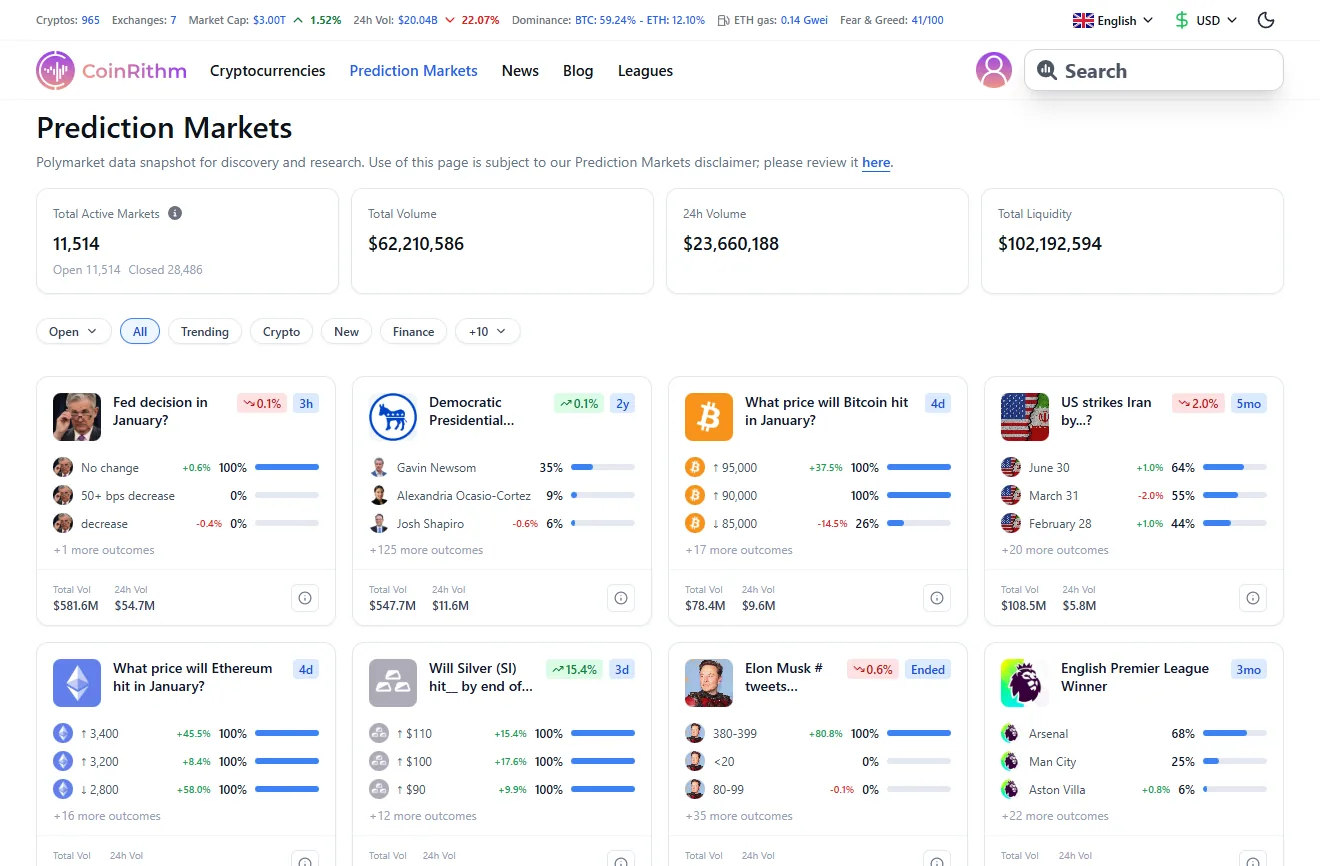
CoinRithm Prediction Markets overview with live stats and category filters.
Step 2: Browse and Filter Markets
Use filter tabs:
- Open - Currently active markets
- All - All markets including closed
- Trending - Rising activity
- Crypto - Bitcoin, Ethereum, crypto markets
- New - Recently created
- Finance - Fed decisions, rates, economic events
- +10 more - Politics, Sports, Entertainment, etc.
Market cards show:
- Market question/title
- Top outcomes with percentages
- 24h change (green/red)
- Time remaining
- Total volume and 24h volume
Step 3: View Market Details
Click any market card to open the detail modal.
Modal sections:
| Section | Information |
|---|---|
| Header | Question, time remaining, 24h change |
| Stats | Total Volume, 24h Volume, Liquidity, 7d Change |
| Timeline | Start -> End date with progress |
| Trends Chart | Price history (24h, 7d, 30d, All) |
| Outcomes | All outcomes with probability and 24h change |
| Rules | Resolution rules and data sources |
Example - "US strikes Iran by..." market:
- Total Volume: $108.5M
- 24h Volume: $5.8M
- Liquidity: $851.5K
- 7d Change: -9.0%
- Started: Dec 22, 2025
- Ends: Jun 30, 2026 (1:00 AM)
Outcomes (sample):
- June 30: 64%
- March 31: 55%
- February 28: 44%
- January 26: 0%
- January 25: 0%
- January 24: 0%
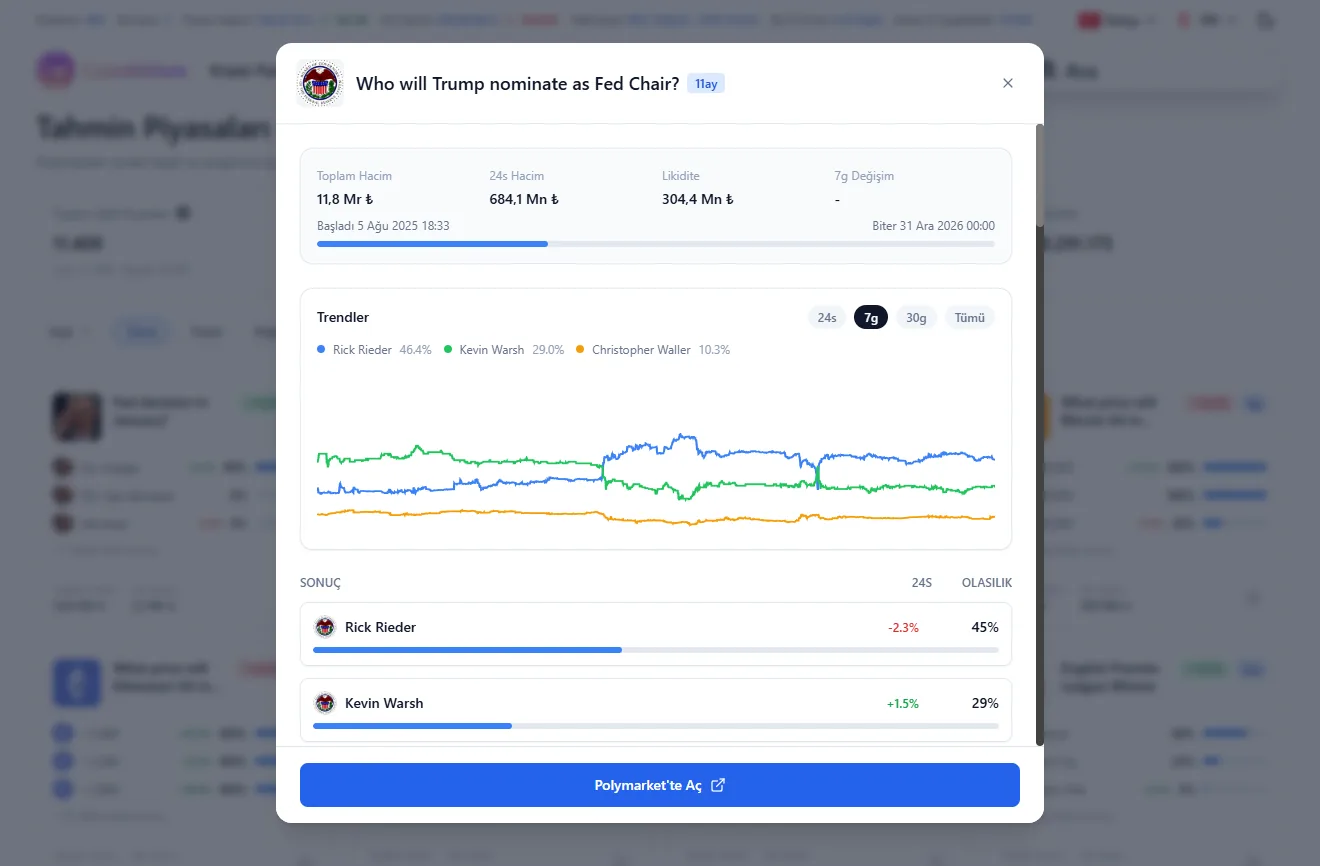
Market detail modal with volume stats, trends chart (24h/7d/30d), outcomes, and resolution rules.
Step 4: Read the Resolution Rules
Scroll down in modal to find Rules section (expand if collapsed).
Example - "US strikes Iran by..." rules:
This market will resolve to "Yes" if the US initiates a drone, missile, or air strike on Iranian soil or any official Iranian embassy or consulate between the time of this market's creation and the listed date (ET). Otherwise, this market will resolve to "No".
For the purposes of this market, a qualifying "strike" is defined as the use of aerial bombs, drones or missiles (including cruise or ballistic missiles) launched by US military forces that impact Iranian ground territory or any official Iranian embassy or consulate.
Missiles or drones which are intercepted and surface-to-air missile strikes will not be sufficient for a "Yes" resolution regardless of whether they land on Iranian territory or cause damage.
Actions such as artillery fire, small arms fire, FPV or ATGM strikes directly, ground incursions, naval shelling, cyberattacks, or other operations conducted by US ground operatives will not qualify.
The resolution source will be a consensus of credible reporting.
Notice the specificity:
- Defines exactly what counts as "strike"
- Excludes intercepted missiles
- Excludes ground operations and cyberattacks
- Specifies resolution source
This detail helps prevent disputes and shows exactly what you are trading.
Step 5: Open on Polymarket
Click "Open on Polymarket" button at modal bottom.
This takes you directly to that market on Polymarket to:
- Connect wallet
- Buy/sell outcome shares
- Track positions
CoinRithm = Discovery. Polymarket = Trading.
How to Trade on Polymarket
Once you have found a market on CoinRithm and understand the rules, here is how to trade.
Creating a Polymarket Account
- Visit polymarket.com
- Click "Sign Up" or "Connect Wallet"
- Connect compatible wallet (MetaMask, Coinbase Wallet, etc.)
- Complete verification if required
Polymarket runs on Polygon (an Ethereum layer 2), so you need a Polygon-compatible wallet.
Funding Your Account
Polymarket uses USDC (USD stablecoin) for trading.
To fund:
- Deposit USDC to your wallet on Polygon
- Or use Polymarket's deposit options (card, crypto transfer)
- Ensure enough for trades + gas fees
Start small. Deposit only what you're comfortable losing while learning.
Placing Your First Trade
- Find market - Search for the market you researched on CoinRithm
- Select outcome - Click outcome you want (e.g., "Yes" or specific candidate)
- Enter amount - Specify USDC amount
- Review - Check shares, price, potential payout
- Confirm - Approve transaction in wallet
Example trade:
- Market: "Bitcoin hits $95,000 in January"
- Outcome: Yes (currently $0.85)
- Spend: $100 USDC
- Receive: ~117 Yes shares
- If Yes wins: $117 (profit $17)
- If No wins: Lose $100
Tracking Your Positions
After trading:
- View positions in Polymarket portfolio
- Watch prices change with news
- Decide: hold to resolution or sell early
You can sell anytime before resolution. Take profits early or cut losses without waiting.
Polymarket vs Other Platforms
The short version:
- Polymarket is strongest for crypto-native users who want broad market variety.
- Kalshi is usually the better fit for US users who want clearer regulated access.
- PredictIt is more limited and generally more expensive.
If platform choice is your main question, use the dedicated support pages instead of relying on this summary:
Is Polymarket Safe and Legit
This is one of the most common questions. Here is the practical answer.
Security and Trust
Polymarket is legitimate with:
- Millions of monthly users
- Billions in cumulative volume
- Transparent on-chain settlement
- UMA oracle system for dispute resolution
However, no platform is 100% safe. Risks include:
- Smart contract vulnerabilities (rare but possible)
- Oracle failures (resolution disputes)
- Regulatory changes affecting access
- Market manipulation in low-liquidity markets
Legal Status by Region
US and regional access rules change over time, so treat any short summary here as directional only.
At a high level:
- US access is the most nuanced and should not be treated the same way as Kalshi
- some European countries have taken a stricter position than others
- access and enforcement posture can change faster than evergreen article copy
For the more careful legal overview, read Are Prediction Markets Legal in the US?.
If you want the practical country-access view, use the prediction market availability overview.
Risk Factors
Before trading on any prediction market:
- Only use money you can afford to lose - Positions can go to zero
- Understand resolution rules - #1 beginner mistake is misunderstanding rules
- Check liquidity - Low liquidity = wider spreads, manipulation risk
- Verify access - Ensure Polymarket works in your region
- Secure your wallet - Use hardware wallets for large amounts
Polymarket Fees and Costs
Polymarket is generally considered one of the cheaper crypto-native options, but “cheap” still depends on:
- your funding method
- the market's liquidity
- whether you are paying card/deposit friction
- how often you trade
The short practical summary:
- trading fees are usually framed around net winnings
- Polygon network costs are usually very small
- spread and liquidity can matter as much as headline fees
If fees are your main question, read Prediction Market Fees Comparison.
Common Beginner Mistakes
Learn from others:
1. Not Reading Resolution Rules
This is the most common mistake. Traders assume they understand the market, then find out the rules define something more narrowly than expected. Always read the rules.
2. Confusing Probability with Certainty
90% probability still fails 10% of the time. Don't bet savings on "sure things."
3. Overtrading
Too many trades = higher fees, lower edge. Be selective.
4. Chasing Hype
Trending doesn't mean you have edge. Do your research.
5. Ignoring Liquidity
Thin markets have wide spreads and manipulation risk. Stick to liquid markets.
6. Emotional Trading
Don't revenge trade after losses. Stick to research.
7. Poor Position Sizing
Never risk more than 5-10% of portfolio on single market. Diversify.
8. Forgetting Fees
Small edges get eaten by fees. Ensure expected profit exceeds costs.
Why Use CoinRithm for Prediction Markets
You can go straight to Polymarket, but CoinRithm adds a few advantages:
| Feature | CoinRithm | Direct Polymarket |
|---|---|---|
| Aggregated View | All markets in one place | Must search/browse |
| Quick Filtering | Category, trend, volume filters | Limited filtering |
| Multi-Language | 8 languages | English-focused |
| Research First | Discovery tool, then trade | Designed for trading |
| No Wallet Needed | Browse freely | Need wallet for details |
| Combined Platform | Same place for crypto tracking, portfolio, paper trading | Separate from portfolio |
Use CoinRithm to:
- Discover interesting markets across categories
- Compare outcomes and trends
- Read resolution rules before committing
- Open on Polymarket when ready to trade
Related: Learn risk-free trading with our Complete Guide to Crypto Paper Trading.
Frequently Asked Questions
What is Polymarket in simple terms
Polymarket is a website where you trade on real-world outcomes. Instead of buying stocks, you buy shares in outcomes like "Will X happen" If you're right, you make money. If wrong, you lose your investment. It's like a stock market for predictions.
How does Polymarket work
Polymarket works by letting users buy and sell outcome shares. Prices range from $0.01 to $0.99 and represent probability. When the event resolves, winning shares pay $1.00, losing shares pay $0.00. An outcome priced at $0.70 means the market thinks there's a 70% chance it happens.
Is Polymarket gambling
Prediction markets share similarities with betting, but the core purpose differs. Prediction markets are designed for information discovery and forecasting - aggregating crowd wisdom to estimate probabilities. There's no house edge; you trade against other participants, not a bookmaker.
Can I lose all my money on Polymarket
Yes. If the outcome you bought resolves against you, your shares become worthless ($0.00). That's why position sizing and risk management matter. Never invest more than you can afford to lose.
Is Polymarket legal in the US
Polymarket has geo-restrictions for US users due to regulatory uncertainty. US residents have limited or no access. For regulated US prediction markets, consider Kalshi (CFTC-regulated) as an alternative.
Is Polymarket safe to use
Polymarket is a legitimate platform with millions of users and billions in volume. It uses transparent blockchain settlement and the UMA oracle for disputes. However, risks exist: smart contract bugs, oracle failures, regulatory changes, and manipulation in thin markets. Only use money you can afford to lose.
How accurate are prediction markets
Prediction markets often outperform polls and expert forecasts, especially for elections and economic events. However, they're not always right. Treat prices as probability estimates, not guarantees. A 90% probability still means 10% chance of being wrong.
Do I need cryptocurrency to use Polymarket
Yes. Polymarket operates on the Polygon blockchain and uses USDC (US dollar stablecoin) for trading. You need a crypto wallet (like MetaMask) with USDC on Polygon to participate.
What is the minimum amount to start on Polymarket
There's no official minimum, but considering gas fees and practical position sizes, $50-$100 USDC is reasonable for learning. Start small until you understand how everything works.
How do prediction market prices work
Prices range from $0.00 to $1.00 and represent estimated probability. A $0.65 price means ~65% chance that outcome happens. When resolved, winning shares pay $1.00, losing pay $0.00. If you buy at $0.65 and win, you profit $0.35 per share.
Can I sell my position before the market resolves
Yes. You can sell shares anytime before resolution. If price moved in your favor, take profits early. If against you, cut losses. You don't have to wait for the event to occur.
What's the difference between Polymarket and Kalshi
Polymarket is decentralized (crypto-based) with broader market variety but US restrictions. Kalshi is centralized and CFTC-regulated, accessible to US residents but with position limits ($25,000/market). Polymarket has lower fees (~2% vs ~1%) but Kalshi offers regulatory compliance for US users.
Conclusion
Polymarket and prediction markets offer a powerful way to see how crowds price future events and, if your information is better, profit from that edge.
What you now know:
- What Polymarket is and how prediction markets work
- How to read prices as probabilities
- Why resolution rules matter (and how to read them)
- How to use CoinRithm for discovery
- Basics of trading on Polymarket
- How to stay safe and avoid common mistakes
Your action plan:
- Start with CoinRithm - Browse Prediction Markets to discover what's active
- Pick a category - Focus on areas where you have knowledge (crypto, politics, sports)
- Read resolution rules - Always understand how markets settle before trading
- Start small - Begin with small amounts while learning
- Track and learn - Review trades and improve over time
Remember:
- Prediction markets are for research and forecasting, not guaranteed profits
- High probabilities can still be wrong
- Only trade what you can afford to lose
- Use CoinRithm for discovery, Polymarket for trading
Next Step
Browse live markets first: CoinRithm Prediction Markets.
Need the step-by-step workflow? Read How to Use Polymarket.
Need the wallet and deposit setup? Read How to Fund Polymarket with USDC.
Need the access and restrictions view? Read Polymarket Countries and Availability.
Need the comparison layer? Read Kalshi vs Polymarket or Best Prediction Markets in 2026.
Last Updated: June 13, 2026
Disclaimer: Prediction markets involve financial risk. This guide is for educational purposes only and is not financial, legal, or investment advice. Verify the legal status of prediction markets in your jurisdiction before participating. Only trade money you can afford to lose.


